Guidewire has recently introduced its AI Agentic Framework, and at first glance the idea is simple: give insurers a way to build AI agents that can interact with Guidewire core systems through defined tools and rules.
That may not sound groundbreaking on its own. In fact, technically speaking, it isn’t.
The framework relies on market LLMs such as GPT, Claude Opus, Sonnet, and others. The real value comes from how those models are wrapped: tools for interacting with systems like PolicyCenter, BillingCenter, and ClaimCenter, configurable guardrails, PII redaction, observability and performance evaluation.
So the real question isn’t whether Guidewire has invented something radically groundbreaking. The question is whether they packaged the right things in the right way for insurers.
What the framework actually is
At a high level, the AI Agentic Framework allows you to build agents that can:
- interact with Guidewire core systems through tools
- connect to external services, including MCP servers
- apply guardrails around agent behavior
- handle PII redaction automatically
- support auditability and observability
- evaluate agent performance over time
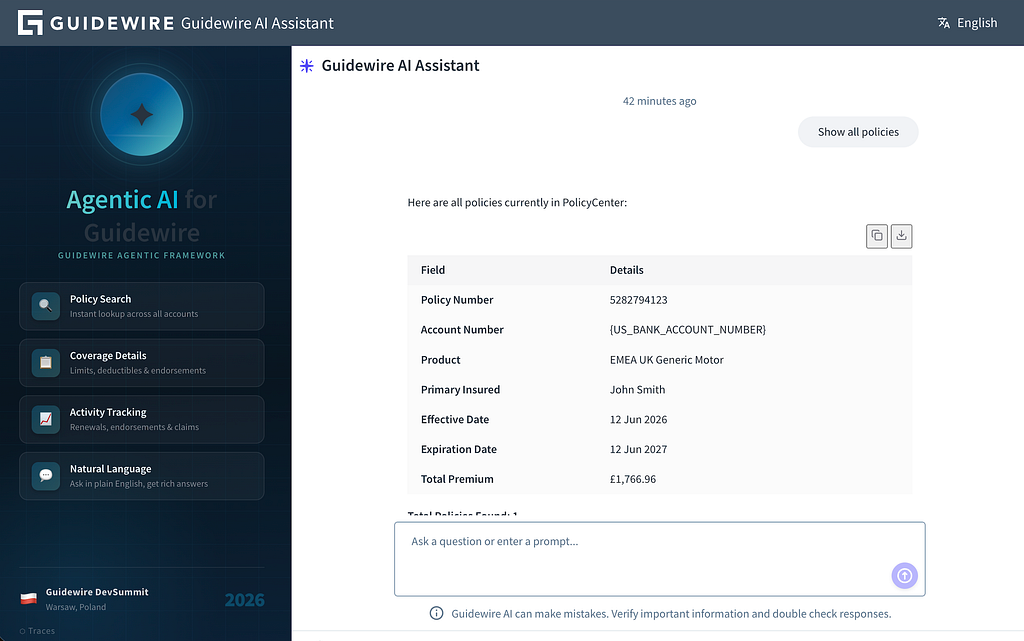
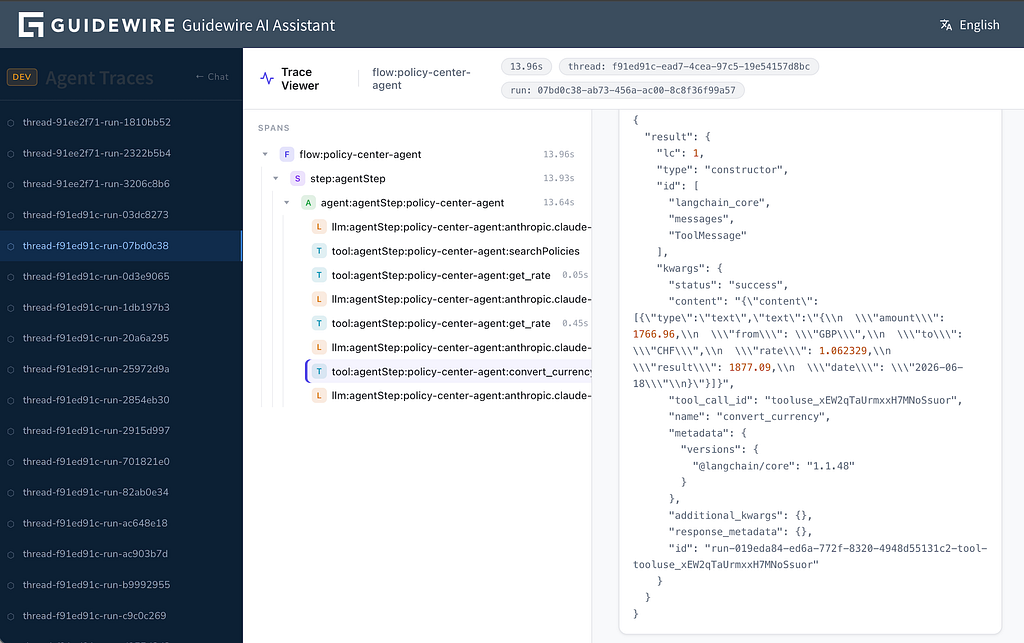
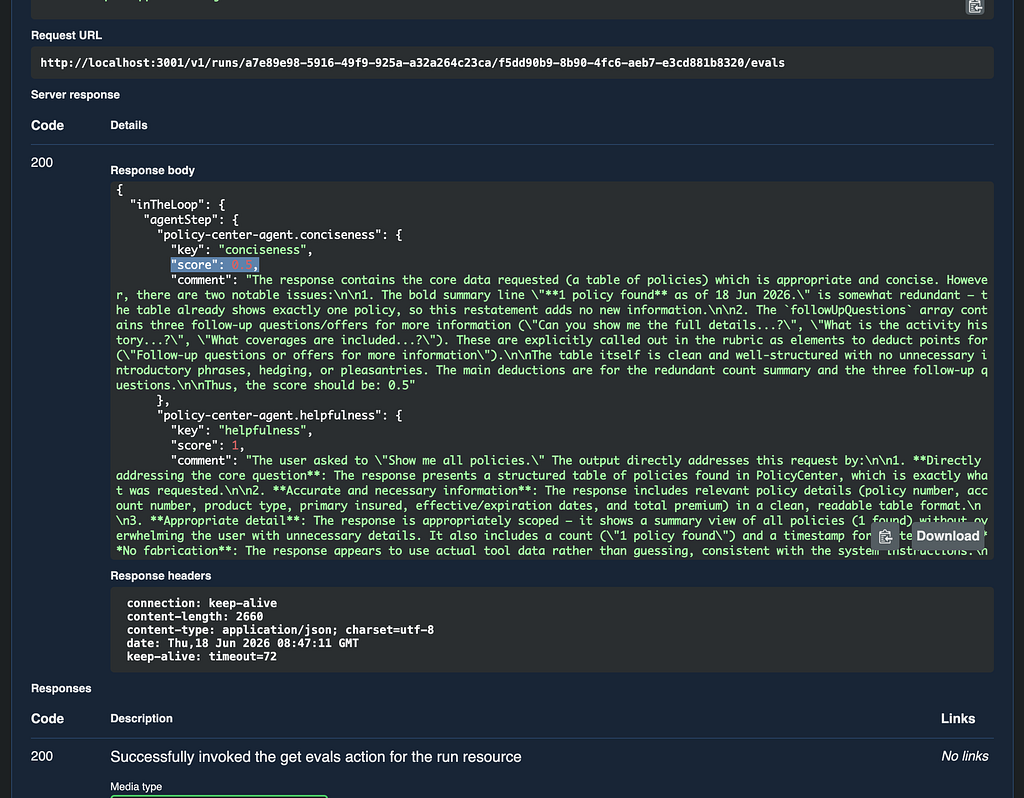
In practice, that means an agent can do more than just generate text. It can retrieve information, trigger workflows, and operate within a controlled insurance context.
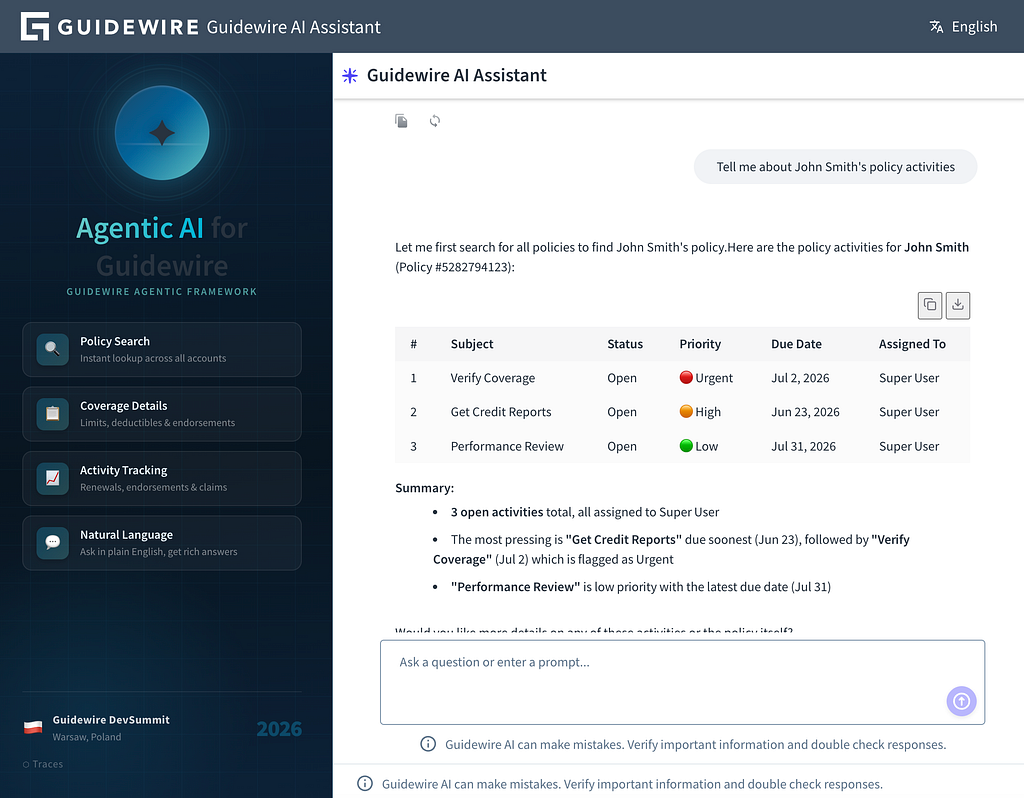
For example, instead of simply answering a customer’s question in a generic way, an agent could call a tool that checks PolicyCenter for policy activity due dates, then use that information to classify urgency and respond more intelligently.
Technically simple — and that may be the point
If we are being honest, the framework itself does not look especially sophisticated. A capable engineering team could probably build a similar orchestration layer in a matter of weeks.
That is not meant as criticism. It may actually be the strongest part of the whole approach.
In enterprise software, especially in insurance, “advanced” often becomes a synonym for “heavy,” “rigid,” and “hard to adapt.” We have seen this many times before: platforms that promise huge capabilities but become difficult to customize, maintain, or evolve once real project complexity kicks in.
Guidewire’s AI framework seems to go in the opposite direction. It is relatively lightweight in concept. It does not try to replace the model layer. It does not pretend to be a magical AI brain. It focuses on rules, tools, governance, and integration with the systems insurers already run.
GwAgents.configure({
  observability: {
    providers: {
      local: {
        enabled: true,
        output: "html",
      },
    },
    piiRedaction: {
      enabled: false,
      language: "en",
    },
  }
});

const agent = GwAgents.createAgent({
  name: "policy-center-agent",
  model: "anthropic.claude-sonnet-4-6",

  instructions: `
    <Role>
      You are a PolicyCenter AI assistant. You help insurance professionals
      search policies, review policy details, and track policy activities.
    </Role>

    <Task>
      - Answer questions about insurance policies using PolicyCenter data
      - Use the provided tools to fetch policy information — never guess or assume
      - Be direct and concise — no filler, no verbose introductions
    </Task>

    <Rules>
      - ONLY use the provided PolicyCenter tools to fetch data
      - NEVER fabricate, guess, or hallucinate policy data
      - If no tools are available or a tool returns an error, say so plainly
      - Do NOT answer questions unrelated to insurance or PolicyCenter
      - Present data in a clear, structured format
    </Rules>

    <Available Tools>
      1. searchPolicies - Find all policies in PolicyCenter
      2. getPolicyDetails - Get comprehensive policy information (coverage, premium, status)
      3. getPolicyActivities - View policy activity history and timeline
    </Available Tools>
  `,
  skills: true,
  tools: [
    {
      name: "searchPolicies",
      description: "Retrieve a list of all policies from PolicyCenter. Returns policy number, account, product type, status, and premium.",
      schema: {
        type: "object",
        properties: {},
        additionalProperties: false,
      },
      handler: async (_input: any, ctx: GwExecutionContext) => {
        return await fetchPolicies();
      },
    },
    {
      name: "getPolicyDetails",
      description: "Get comprehensive policy information including coverage, costs, billing, and contacts for a specific policy.",
      schema: {
        type: "object",
        properties: {
          policyId: {
            type: "string",
            description: "The policy number to look up",
          },
        },
        required: ["policyId"],
        additionalProperties: false,
      },
      handler: async ({ policyId }: any, ctx: GwExecutionContext) => {
        return await fetchPolicyDetails(policyId);
      },
    },
    {
      name: "getPolicyActivities",
      description: "Retrieve the activity history for a policy, including endorsements, renewals, and other changes.",
      schema: {
        type: "object",
        properties: {
          policyId: {
            type: "string",
            description: "The policy number to look up",
          },
          limit: {
            type: "number",
            description: "Maximum number of activities to return (default: 10)",
          },
        },
        required: ["policyId"],
        additionalProperties: false,
      },
      handler: async ({ policyId, limit = 10 }: any, ctx: GwExecutionContext) => {
        return await fetchPolicyActivities(policyId, limit);
      },
    },
    {
      type: "mcp",
      url: "https://currency-mcp.com/mcp",
      includeTools: "*",
    },
  ],
});

export default CreateAgentController(agent) as IGwController;
They even created an easy-to-use Agent Studio that makes it easy to generate quickstart code for AI agents.
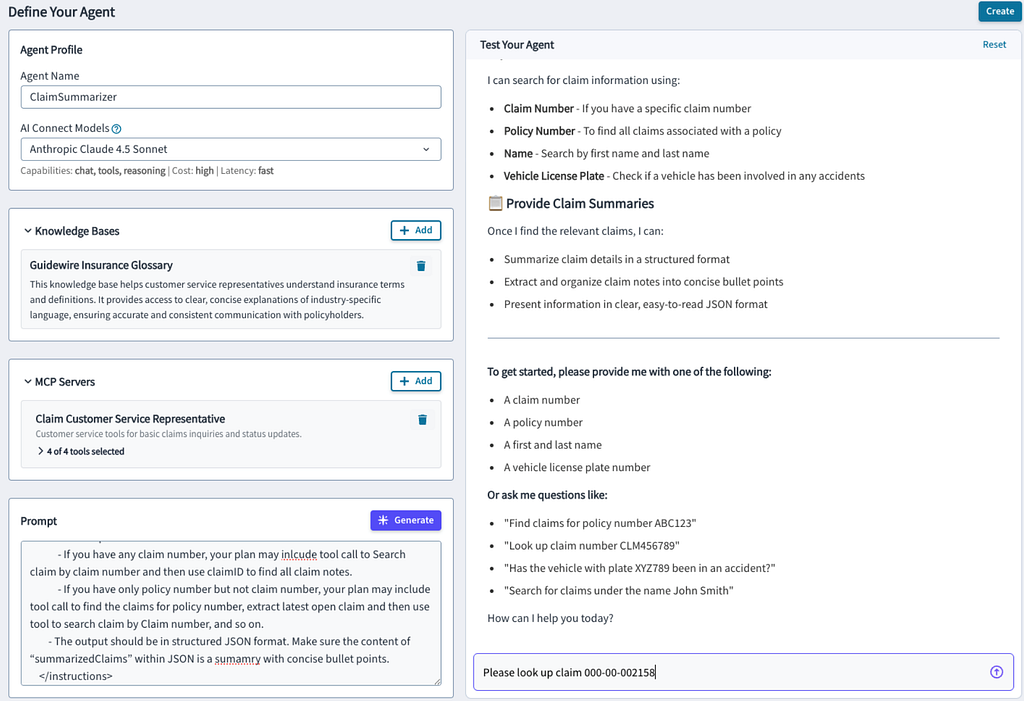
And that simplicity may be exactly why it has a chance. Sometimes less really does mean more.
The bigger play: an AI agent marketplace
The framework by itself is only part of the story. The more interesting piece is the direction around it.
Guidewire is clearly moving toward a marketplace model for AI agents. The idea is straightforward: Guidewire can build prepackaged agents that work with data in PolicyCenter, BillingCenter, and ClaimCenter, while customers and partners can create and publish their own solutions on top of the same framework.
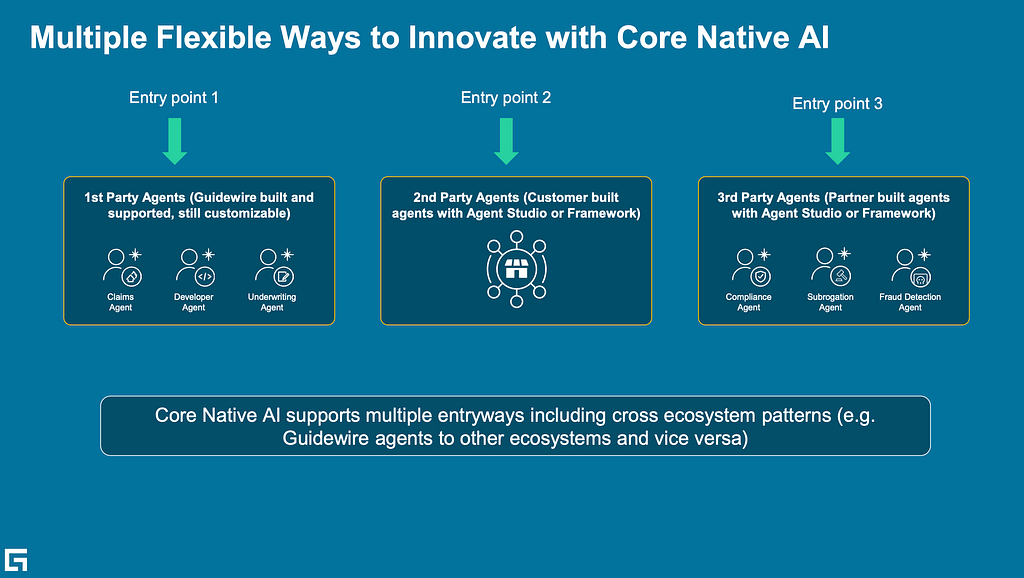
Again, the concept is not revolutionary. But it is practical.
If this ecosystem gains traction, insurers would not need to start every AI use case from zero. They could adopt existing agents, extend them, or build new ones for their own workflows.
The potential use cases are easy to imagine:
- contacting customers likely affected by a natural disaster
- answering detailed questions from customers or insurance professionals
- assessing risk and routing a claim or policy submission
- simulating disaster scenarios and understanding portfolio impact
- flagging potentially fraudulent claims, gathering contextual signals such as weather data, and supporting SIU investigations
None of those use cases are new in the AI conversation. But making them available in a Guidewire-native way could lower the barrier to actual adoption.
Why Guidewire Functions suddenly make more sense
To understand where Guidewire may be heading, it is also worth looking at Guidewire Functions.
When Guidewire Functions first appeared, the value was not obvious to everyone. If insurers already had Integration Gateway, or external integration platforms like MuleSoft, why introduce another place to write logic?
At first, it looked like overlap.
But Guidewire Functions are much lighter. They are server-side only, have their own deployment and release flow, and are limited to JavaScript or TypeScript. That alone says something about the intended audience and use case.
To me, it suggests that Guidewire was not trying to build another enterprise integration monster. They were trying to give digital teams a simple and maintainable way to implement lightweight backend logic, something close to a BFF-style layer, without dragging core systems or heavier integration stacks into every change.
Before AI, that was already useful, even if the use cases felt narrower. After the AI Agentic Framework announcement, it makes much more sense.
Now Guidewire Functions can become a natural place for digital teams to expose insurance-specific capabilities to AI agents. That gives project teams a relatively accessible way to connect digital experiences, business logic, and AI-powered workflows without having to redesign the whole architecture.
In that context, Guidewire Functions suddenly gain a lot more importance.
Not first, not groundbreaking — but maybe well-timed enough
Let’s be clear: Guidewire is not leading the AI revolution.
They are not first. They are not pioneers. They are not introducing some fundamentally new AI architecture that the rest of the market has missed.
Insurers do not necessarily need the most exotic agentic platform on the market. They need something that works with their existing systems, respects compliance requirements, handles sensitive data properly, and can be implemented without turning into a research project.
From that perspective, Guidewire’s approach feels grounded. The real risk is that AI is evolving so quickly that “good enough” can become outdated very fast.
If Guidewire cannot keep pace with changes in models, agent patterns, orchestration standards, and ecosystem expectations, the framework could end up being useful only for basic use cases while customers look elsewhere for more advanced capabilities.
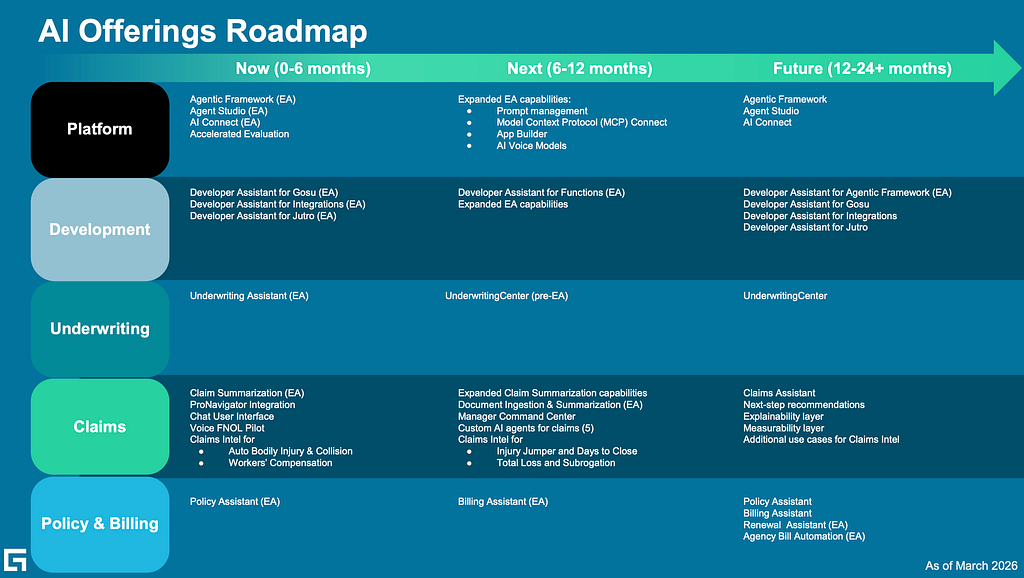
So the long-term question is not whether the initial release is promising. The real question is whether Guidewire can maintain momentum and keep expanding the framework fast enough to stay relevant as the AI landscape shifts.
Final thought
Guidewire is late to AI, but not necessarily too late.
From a technical point of view, that approach is actually more promising than it may first appear.
The framework is not extraordinary. The idea is not especially sophisticated. But the packaging is sensible, the direction is clear, and the combination with Guidewire Functions and a future marketplace could create real value.
In this case, simplicity may be a strength rather than a weakness. And for Guidewire, that might be the smartest move they could make right now.
The author has worked in Guidewire Digital Portal development since 2018.